|
|

Wireless Fidelity (Wi-Fi)
Introduction
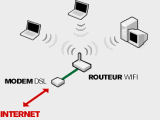 Wi-Fi (also WiFi, Wi-fi, Wifi, or wifi) is a brand originally licensed by the Wi-Fi Alliance
to describe the underlying technology of wireless local area networks (WLAN) based on the IEEE 802.11
specifications. Wi-Fi is now so pervasive, and the term so generic, that the brand is no longer
protected and it appears in Webster's dictionary.
Wi-Fi was intended to be used for mobile computing devices, such as laptops, in LANs, but is now
often used for increasingly more applications, including Internet and VoIP phone access, gaming,
and basic connectivity of televisions, DVD players, Wi-Fi Internet Radio and other consumer
electronics. There are even more standards in development that will allow Wi-Fi to be used by
cars in highways in support of an Intelligent Transportation System to increase safety, gather statistics,
and enable mobile commerce IEEE 802.11p.
Wi-Fi (also WiFi, Wi-fi, Wifi, or wifi) is a brand originally licensed by the Wi-Fi Alliance
to describe the underlying technology of wireless local area networks (WLAN) based on the IEEE 802.11
specifications. Wi-Fi is now so pervasive, and the term so generic, that the brand is no longer
protected and it appears in Webster's dictionary.
Wi-Fi was intended to be used for mobile computing devices, such as laptops, in LANs, but is now
often used for increasingly more applications, including Internet and VoIP phone access, gaming,
and basic connectivity of televisions, DVD players, Wi-Fi Internet Radio and other consumer
electronics. There are even more standards in development that will allow Wi-Fi to be used by
cars in highways in support of an Intelligent Transportation System to increase safety, gather statistics,
and enable mobile commerce IEEE 802.11p.
Advantages of Wi-Fi
There are several good reasons that make wi-fi become a useful technology for us:
Allows LANs to be deployed without cabling, typically reducing the costs of network
deployment and expansion. Spaces where cables cannot be run, such as outdoor areas
and historical buildings, can host wireless LANs. Wi-Fi silicon pricing continues to come down, making Wi-Fi a very economical networking
option and driving inclusion of Wi-Fi in an ever-widening array of devices. Wi-Fi products are widely available in the market. Different brands of access points
and client network interfaces are interoperable at a basic level of service. Products
designated as Wi-Fi CERTIFIED by the Wi-Fi Alliance are interoperable and include WPA2 security. Wi-Fi networks support roaming, in which a mobile client station such as a laptop computer
can move from one access point to another as the user moves around a building or area. Wi-Fi is a global set of standards. Unlike cellular carriers, the same Wi-Fi client works
in different countries around the world. Widely available in more than 250,000 public hot spots and millions of homes and corporate
and university campuses worldwide. As of 2006, WPA and WPA2 encryption are not easily crackable if strong passwords are used New protocols for Quality of Service (WMM) and power saving mechanisms (WMM Power Save) make
Wi-Fi even more suitable for latency-sensitive applications (such as voice and video) and small
form-factor devices.
|
|
 Digital Subscriber Line Digital Subscriber Line
 Wireless Fidelity (Wi-Fi) Wireless Fidelity (Wi-Fi)
 IP-PABX IP-PABX
 Gigabit Ethernet Gigabit Ethernet
 IPTV IPTV
 Dedicated Line Dedicated Line
|


