|
|

IP-PABX
Introduction
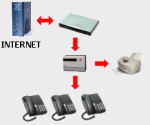 In regular telephone systems, a PBX (private branch exchange) is the switching system that manages calls
between internal or local users. It also shares a number of lines that connect to the external, public phone
system and parcels them out as needed to the local users. In addition, enterprise PBX systems have other
features that allow them to take incoming calls, send them to the correct extensions, connect calls to
answering services, etc. A typical PBX consists of a set of external phone lines, a computer server system
that manages call switching, a set of internal phone lines and some form of console for manual control. In regular telephone systems, a PBX (private branch exchange) is the switching system that manages calls
between internal or local users. It also shares a number of lines that connect to the external, public phone
system and parcels them out as needed to the local users. In addition, enterprise PBX systems have other
features that allow them to take incoming calls, send them to the correct extensions, connect calls to
answering services, etc. A typical PBX consists of a set of external phone lines, a computer server system
that manages call switching, a set of internal phone lines and some form of console for manual control.
In VoIP or IP telephony systems, the IP-PABX does all this and more. It performs all the switching and
connecting of VoIP calls. In many cases it does the same for regular telephone calls (in systems that can
handle both kinds of phone system). It is also highly programmable and can perform advanced functions
including voice menu systems, automatic call conferencing, click-to-call (click on a contact record on a
PC screen to initiate a voice call), call logging and tracking and much more. Using an IP-PABX system
and VoIP telephone service allows an organization to combine (or converge) voice and data networks
into a single system for cost-savings, simpler management and greater functionality.
Typically an IP-PABX system is a piece of software running on a server . Depending on the workload,
that server can also be performing other tasks, but usually it is dedicated and also acts as the VoIP
system's connection to the internet. IP-PABX systems can come as software for you to install on an
existing server of your own, or as preconfigured software on a server, or even as a turnkey box that
is completely set up in advance to just connect to your existing network.
Why you need an IP-PABX
Any IP telephony setup that is for more than two or three lines needs a switching system to make
it more efficient, allow internal calling and switching between users and to provide more advanced
features like voicemail, call forwarding, call hold, conferencing and more. Typically IP-PABX systems
become economically sensible with as few as 5 users and a good rule of thumb is that if you want
an IP telephony system with extensions for your users than you will want an IP-PABX.
In addition, market and analyst estimates show that there is a rapid migration to IP telephony
underway because of cost, efficiency and performance advantages. Any organization, even a small one
that migrates to VoIP or IP telephony will need an IP-PABX system. In the past PBX systems for
organizations and enterprises cost so much that only large enterprises could afford to make use
of them, but recent technological advances and pressure from open source solutions has brought
the cost of IP-PABX systems down to as low as well under $1000.
|
|
 Digital Subscriber Line Digital Subscriber Line
 Wireless Fidelity (Wi-Fi) Wireless Fidelity (Wi-Fi)
 IP-PABX IP-PABX
 Gigabit Ethernet Gigabit Ethernet
 IPTV IPTV
 Dedicated Line Dedicated Line
|


